Explore battery drain solutions to protect and enhance your vintage vehicle's reliability.
Learn how battery safety affects classic car performance. Discover solutions to prevent battery drain, protect sensitive electronics, and ensure your vintage car is always show-ready.
TL;DR
-
Battery drain kills classic car performance - Parasitic draw damages batteries and leaves you stranded at shows when you least expect it
-
Measure your baseline first - Use a multimeter to check parasitic draw; anything over 100 milliamps needs investigation
-
Physical isolation is the most reliable solution - Disconnecting the negative terminal stops all drain instantly; quick-release terminals like the Klamp make this practical for regular use
-
Monitor voltage during storage - Check weekly and maintain records; batteries losing more than 0.1 volts per week while isolated may be failing
- Consistency matters more than perfection - Establish a routine for isolation and monitoring; occasional attention provides incomplete protection
What This Guide Covers
This guide addresses battery drain solutions specifically for classic car collectors who store vehicles for extended periods. You will learn why battery safety matters for vintage vehicle performance and how to prevent the slow electrical death that claims countless classic cars each year.
By the end, you will understand the relationship between battery drain and classic car performance, identify warning signs before damage occurs, and implement practical solutions that protect your investment. This guide focuses on storage and intermittent-use scenarios rather than daily drivers.
We cover prevention, detection, and resolution. We do not cover battery rebuilding, alternator diagnostics, or period-correct restoration debates.
Why Battery Safety Determines Classic Car Performance
Classic cars present unique electrical challenges that modern vehicles simply do not face. Vintage wiring degrades over decades. Original components draw power in ways engineers never anticipated during long-term storage.
When battery safety is ignored, the consequences extend far beyond a flat battery. Parasitic drain damages sensitive electronics in cars never designed to sit idle for weeks. Sulfation permanently reduces battery capacity. Corroded terminals create resistance that starves starters and ignition systems.
The real cost appears at the worst moment. You arrive at a show with a car that cranks slowly or not at all. Classic car performance depends on electrical reliability, and that reliability starts with proper battery management.
Core Concepts You Need to Understand
Parasitic Drain vs. Normal Discharge
Every battery loses charge over time through natural chemical processes. This normal self-discharge amounts to roughly 1-2% per month in healthy batteries. Parasitic drain is different. It occurs when electrical components continue drawing power with the ignition off.
Classic cars suffer from both problems simultaneously. Aged wiring insulation breaks down, creating unexpected current paths. Aftermarket accessories installed decades ago may lack proper switching. Even factory clocks and memory circuits draw milliamps continuously.
The Isolation Principle
Battery drain solutions share one fundamental approach: interrupt the circuit when the vehicle sits unused. Complete electrical isolation prevents all parasitic drain and dramatically slows self-discharge by eliminating any load.
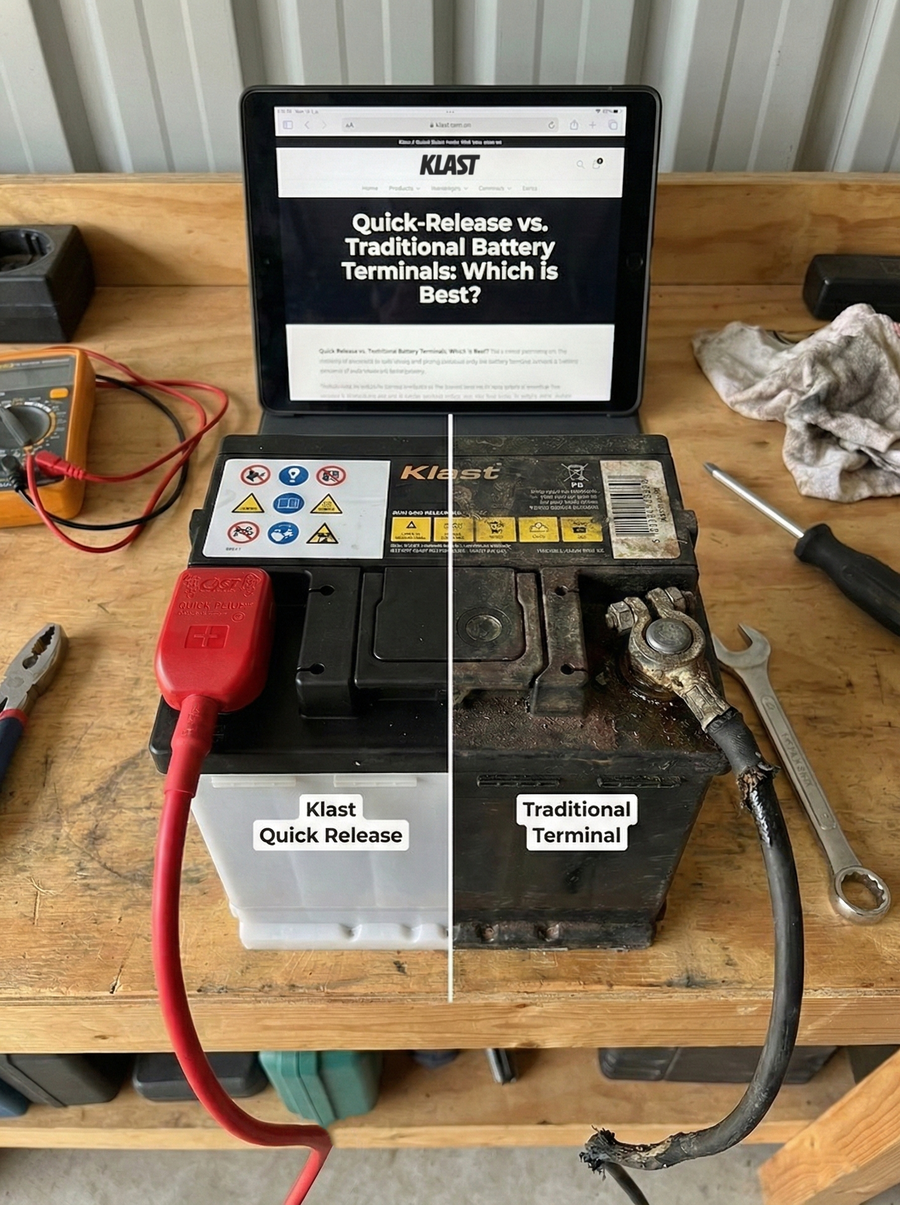
Traditional methods involve removing cables or installing master switches. Modern solutions like the Klamp quick-release terminal achieve the same result without tools or permanent modifications to original equipment.
Voltage Thresholds That Matter
A fully charged 12-volt battery reads approximately 12.6 volts at rest. At 12.4 volts, the battery has lost roughly 25% of its charge. Below 12.0 volts, sulfation accelerates and permanent damage begins. Classic car performance suffers noticeably when starting voltage drops below 12.2 volts.
The Three-Stage Battery Protection Framework
Effective battery drain solutions follow a logical sequence: prevent unnecessary discharge, detect problems early, and respond before damage occurs. Each stage builds on the previous one.
Prevention eliminates the primary causes of drain. Detection catches issues that prevention misses. Response provides immediate solutions when problems arise. This framework applies whether your classic car sits for a weekend or an entire winter.
The stages interconnect. Better prevention reduces detection burden. Earlier detection enables simpler responses. Faster response prevents the cascade of damage that transforms a minor drain into a major restoration expense.
Step-by-Step Battery Drain Solutions
Step 1: Assess Your Current Drain Situation
Objective: Establish a baseline measurement of your vehicle's parasitic draw.
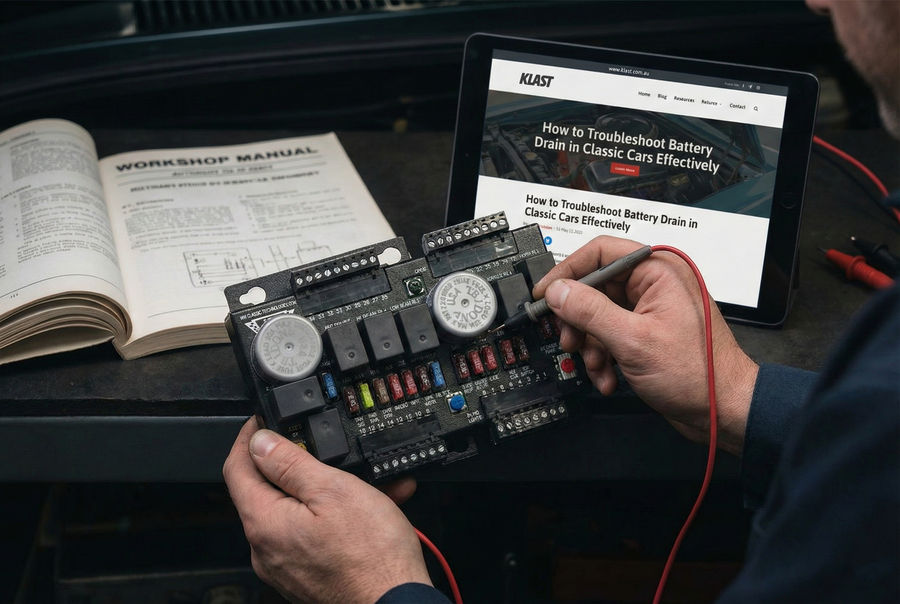
Connect a multimeter in series between the negative battery terminal and cable. Set it to measure DC amps. Wait 20 minutes for all systems to enter sleep mode (if applicable). Record the reading.
Classic cars without electronic modules should draw less than 25 milliamps. Vehicles with aftermarket stereos, alarms, or electronic ignitions may draw 50-85 milliamps. Anything above 100 milliamps indicates a problem requiring investigation.
Avoid: Testing immediately after opening doors or turning off ignition. Modern components need time to power down. Testing too soon produces artificially high readings.
Success indicator: You have a documented baseline number and understand whether it falls within acceptable limits for your specific vehicle configuration.
Step 2: Eliminate Unnecessary Drain Sources
Objective: Reduce parasitic draw to the minimum required for your vehicle's systems.
Pull fuses one at a time while monitoring your multimeter. When the reading drops significantly, you have identified a circuit with excessive draw. Investigate that circuit for faults, aftermarket additions, or components that should be switched but are not.
Common culprits in classic cars include trunk lights that stay on, glove box lights with failed switches, and aftermarket radios with constant memory draw. Interior lights deserve special attention since door switches often fail in older vehicles.
Avoid: Disconnecting circuits permanently without understanding their function. Some draws are necessary and expected. Others indicate wiring faults that could present fire hazards.
Success indicator: Parasitic draw falls below 50 milliamps, or you understand exactly what is drawing power and why.
Step 3: Implement Physical Isolation
Objective: Create a reliable method to completely disconnect the battery during storage.
Physical isolation remains the most effective battery drain solution for classic cars. When the circuit is broken, no current flows. Period. This protects against both known drains and undiscovered faults.
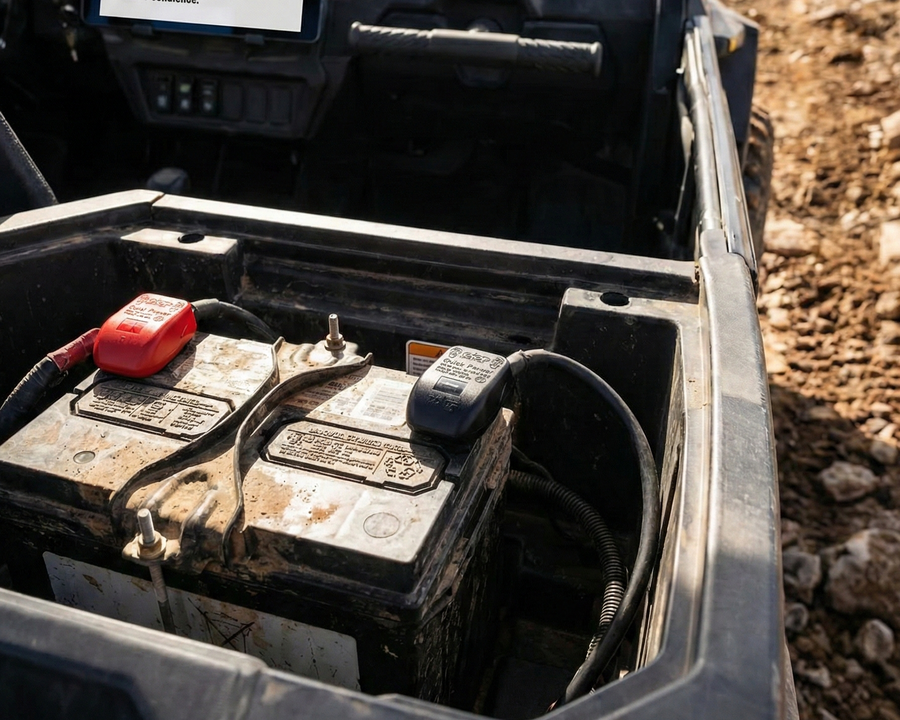
Options range from simply removing the negative cable to installing quick-release terminals. The Klamp from Klast provides tool-free disconnection in seconds, making isolation practical for regular use rather than just seasonal storage.
Position your isolation point at the negative terminal. This maintains the vehicle's ground reference and reduces spark risk during reconnection. Ensure the disconnected terminal cannot accidentally contact any metal surface.
Avoid: Relying solely on battery disconnect switches mounted remotely. These add resistance, create additional failure points, and often require permanent modifications to original wiring.
Success indicator: You can isolate the battery in under 30 seconds without tools and reconnect just as quickly before driving.
Step 4: Establish a Monitoring Routine
Objective: Catch developing problems before they cause damage or leave you stranded.
Check battery voltage weekly during storage periods. Use a quality digital multimeter or a dedicated battery monitor. Record readings to track trends over time. A battery losing more than 0.1 volts per week (while isolated) may be failing internally.
Visual inspection matters too. Check terminal connections for corrosion. Inspect battery case for cracks, bulging, or leaking. Examine cable insulation for brittleness or damage.
Avoid: Assuming a battery is fine because the car started last time. Marginal batteries fail suddenly, often when temperature drops or after sitting slightly longer than usual.
Success indicator: You have a log of voltage readings and can identify trends before they become failures.
Step 5: Maintain Charge During Extended Storage
Objective: Keep the battery at optimal charge level without overcharging or creating fire risk.
For storage beyond two weeks, consider a quality float charger or battery maintainer. These devices monitor voltage and provide small charging pulses as needed. They prevent sulfation without overcharging.
Connect the maintainer before isolating the battery if your setup allows, or reconnect periodically for charging sessions. Some collectors prefer monthly charging cycles rather than continuous connection.
Avoid: Using automotive chargers designed for rapid charging. These can overcharge and damage batteries left connected. Avoid cheap maintainers without proper float-mode circuitry.
Success indicator: Battery voltage remains between 12.4 and 12.8 volts throughout storage, and the battery accepts a full charge when needed.
Practical Application: The Weekend Show Car
Consider a 1972 muscle car driven to shows twice monthly during summer and stored from November through March. The owner installed a modern stereo years ago. The car has its original wiring otherwise.
Without intervention, the stereo's memory circuit draws 40 milliamps continuously. Combined with a small draw from the electronic ignition module, total parasitic drain reaches 65 milliamps. The battery loses meaningful charge within two weeks.
The solution combines approaches. A Klamp on the negative terminal allows 10-second disconnection after each drive. During winter storage, the owner removes the battery entirely, stores it on a maintainer in the garage, and reinstalls it each spring.
The result: reliable starting at every show, no roadside embarrassments, and batteries that last 5-6 years instead of 2-3. Classic car performance remains consistent because electrical reliability is never in question.
Common Mistakes That Compromise Battery Safety
The most frequent error is assuming that short storage periods do not matter. Two weeks seems brief, but marginal batteries fail in less time. Consistent isolation prevents cumulative damage regardless of storage duration.
Many collectors over-rely on trickle chargers while ignoring underlying drain problems. Chargers mask symptoms without addressing causes. The drain continues stressing wiring and components even when the battery stays charged.
Another mistake involves inconsistent practices. Disconnecting the battery sometimes but not always provides incomplete protection. Battery safety requires routine, not occasional attention.
Finally, some owners modify original wiring to install master switches when simpler solutions exist. Preserving originality matters for classic car value. Quick-release terminals like the Klamp achieve isolation without permanent changes.
What to Do Next
Start with Step 1. Measure your current parasitic draw this weekend. That single number tells you whether you have an urgent problem or simply need better isolation practices.
If your draw exceeds 100 milliamps, investigate before your next storage period. If it falls within acceptable limits, implement physical isolation and establish your monitoring routine.
Consider this guide a reference rather than a one-time read. Return to specific sections as your situation changes. Battery drain solutions evolve as vehicles age and usage patterns shift.
For tool-free isolation that takes seconds, explore the Klamp from Klast. Swedish-engineered for reliability, it transforms battery disconnection from a chore into a habit. Questions about fitment or installation? Contact Klast directly for support from their Adelaide team.
Frequently Asked Questions
How long can a classic car sit before battery drain becomes a problem?
Most classic cars with typical parasitic draws (50-80 milliamps) will struggle to start after 3-4 weeks of sitting. Vehicles with higher draws or older batteries may fail sooner. Physical isolation eliminates this concern entirely, allowing indefinite storage without battery damage.
Will disconnecting the battery reset my clock and radio presets?
Yes, any memory-dependent features will reset when power is removed. For most classic car collectors, this minor inconvenience is preferable to dead batteries and potential electrical damage. Some owners keep a small notebook in the glove box with radio presets for quick reprogramming.
Can I use a battery disconnect switch instead of quick-release terminals?
Battery disconnect switches work but have drawbacks. They require permanent installation, add resistance to the circuit, and create additional failure points. Quick-release terminals like the Klamp provide the same isolation benefit without modifying original wiring or adding components that can fail.
Should I disconnect the positive or negative terminal?
Always disconnect the negative terminal first and reconnect it last. This maintains the vehicle's ground reference and minimizes spark risk. Disconnecting the positive terminal while the negative remains connected creates potential short-circuit hazards if tools contact any grounded metal.
How do I know if my battery is damaged from previous drain issues?
A battery that will not hold charge above 12.4 volts after a full charging cycle has likely suffered sulfation damage. Other signs include slow cranking despite showing adequate voltage, visible swelling of the case, or white crystalline deposits around terminals. Once sulfation sets in, the battery requires replacement.
Do modern AGM batteries handle drain better than traditional flooded batteries?
AGM batteries have lower self-discharge rates and tolerate deeper discharge cycles better than flooded batteries. However, they still suffer from parasitic drain and sulfation. The same isolation practices apply regardless of battery chemistry. AGM batteries cost more, so protecting them through proper isolation makes even more financial sense.